Concealed water migration inside multi-story Pelham Parkway row houses, pre-war apartment buildings, and two-family residences can compromise structural plaster, ruin floorboards, and lead to mold outbreaks before surface dampness is ever noticed. Our professional plumbers locate hidden supply and hydronic leaks accurately without destructive demolition.
Water follows gravity and structural joists, meaning moisture appearing on a ceiling often originates many feet horizontally away from where it drips. In the dense housing blocks surrounding Pelham Parkway, Morris Park, and Bronxdale, homeowners and tenants regularly experience:
Yellowish rings, sagging plaster lath, or water-filled latex paint bubbles on ceiling sheets typically signal active plumbing runs overhead, such as branch drains, tub traps, or heating risers.
Hardwood buckling, damp basement subflooring, or unexpectedly warm patches on bathroom tiles often point to embedded hydronic heating tubes or leaking domestic hot water copper lines.
If your DEP municipal water meter continues turning while every faucet is shut off, or you hear faint hissing behind sheetrock, pressurized supply pipes are actively discharging water.
Rather than chopping open entire plaster walls or tearing up hardwood planks on guesswork, our technical approach applies calibrated diagnostic steps to pinpoint the exact failure zone:
We test cold water supply, hot water recirculation lines, and boiler hydronic loops independently with pressure gauges to isolate which plumbing subsystem has lost hydraulic pressure.
Infrared thermography detects subtle temperature variations behind walls and ceilings, highlighting the precise path of leaking heated water or evaporative cooling created by wet building insulation.
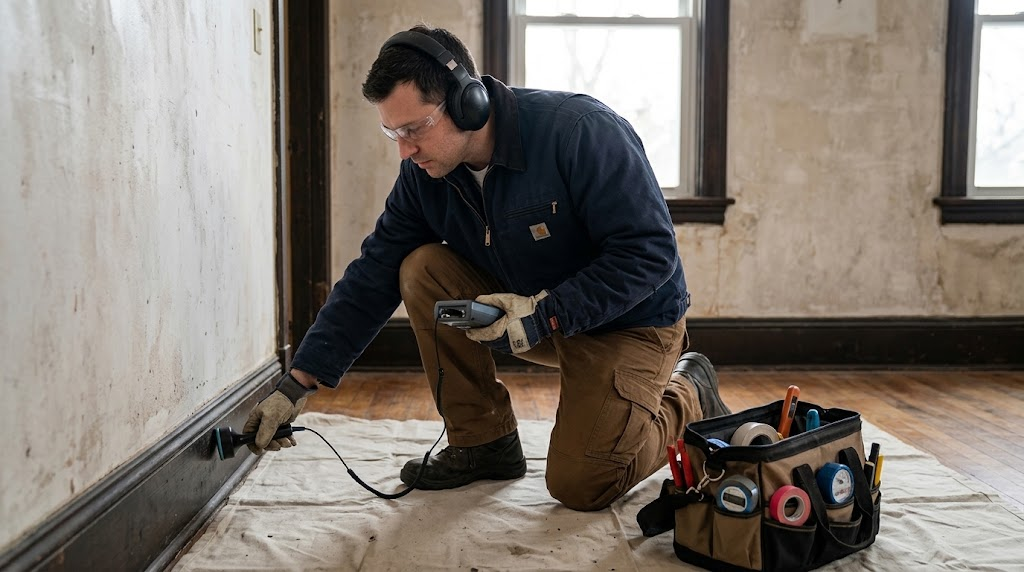
High-sensitivity ground and wall microphones amplify the acoustic frequency produced by pressurized water escaping microscopic fissures in copper, PEX, or brass fittings.
Once the exact location is marked, an access point is cut only where needed to perform the required pipe soldering, press-fitting, or drain coupling replacement.
Tracing a leak in a multi-unit Bronx building often requires inspecting both the ceiling of the affected unit and the fixtures, riser chases, and radiator valves of the unit directly above. A slow drip from a faulty wax ring, shower pan failure, or an unseated radiator vent can seep downward between subflooring layers for weeks before dripping through the lower ceiling. We assist owners, landlords, and tenants with professional, courteous diagnostics that pinpoint the exact source quickly and clearly.
Once a leak is accurately detected, the scope and method of permanent repair depend on several physical building characteristics:
We utilize non-invasive diagnostic methodologies including precision acoustic pipe listening devices, thermal imaging moisture mapping, and isolation pressure testing. These techniques allow us to trace pressurized supply lines and concealed drainage pathways to pinpoint the leak origin before recommending any focused drywall or plaster opening.
Place buckets or plastic containers underneath the drip immediately to protect floors, and gently pierce bulging paint blisters with a pencil tip to relieve trapped hydraulic weight. Notify the upstairs neighbor or building super promptly to shut down fixture valves or main risers, and call (315) 202-8009 for prompt professional leak tracing.
Yes. Radiator air vents that stick open, loose spud unions, packing nut weepage, and uninsulated steam riser expansions can drip water downward through floor penetrations into the ceiling cavity below, especially when steam cools and condenses.
An unexplained spike in water consumption typically points to a concealed underground supply line rupture, an autofill boiler valve continuously dumping water into the heating system, or a silent flapper leak inside a bathroom fixture.
Concealed moisture issues frequently connect to residential heating loops, radiator piping, or underground sewer connections. Explore related services:
Discover how concealed boiler water leaks affect heating pressures and boiler safety controls.
Explore Boiler Repair →Resolve weeping radiator valves, spitting steam vents, and ceiling water stains caused by heating lines.
Explore Radiator Repair →Identify underground pipe cracks, sewer gas odors, and drainage breaks using camera inspection tools.
Explore Sewer Line Repair →Call us to discuss your symptoms. We provide non-invasive diagnostic tracing throughout Pelham Parkway, Morris Park, and surrounding Bronx areas.